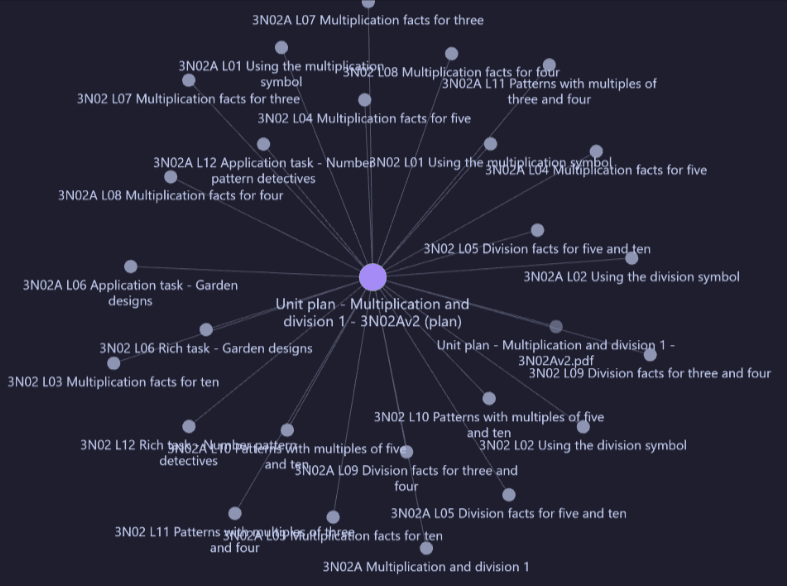
This is the first of a series of blog posts describing the intent and development of Ochre Education’s Knowledge Graphs.
For the past five years, the Ochre team have been working with practising teachers to develop an ambitious and knowledge-rich curriculum. We believe that all students deserve equitable access to a high quality curriculum that allows them to build knowledge and skill over time. A knowledge-rich curriculum provides opportunities for students to learn ambitious content and skills, powerful knowledge, that have been specified and well-sequenced over time. This access to a knowledge-rich curriculum empowers students to acquire knowledge that takes them beyond their lived experiences.
The starting point of this work is to develop and codify curriculum knowledge and skills for English, Maths, science, history and geography. This painstaking work involves unpacking content descriptions and content points, determining what knowledge and skill is explicitly described and what is implicitly assumed in each element of the curriculum, and then smoothing the lumps in the national and state curricula to create a coherent sequence.
The backbone of this work is the careful chunking and sequencing of learning across time and between subject areas. The value of a knowledge-rich and coherent curriculum lies in part in its connections and sequencing. Whenever we create a curriculum, and associated curriculum materials, we need to break complex ideas into smaller chunks that are sequenced over time. In some cases the size and order of these chunks is self-evident; in others it is a more fluid choice, guided by national curriculum requirements or judgements of the team working on the project.
The chunking and sequencing of units in the Ochre curriculum materials are shown in the progression diagrams. These diagrams show the dependencies that exist between units, supporting schools who are keen to adjust the order of units, or replace units in the Ochre sequence with units of their own.
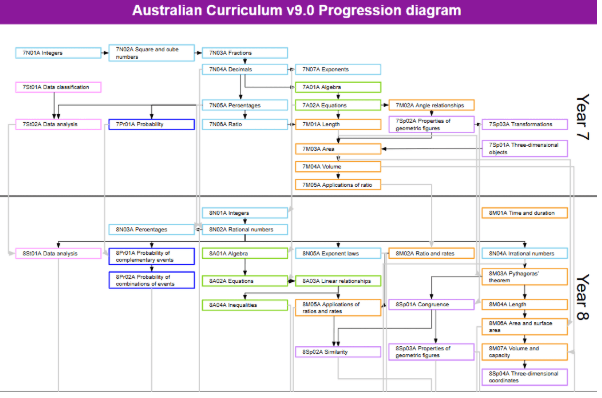
As always, our team is keen to find ways to improve our work. So, to supplement the dependencies and relationships described in the progression diagrams, our team has been creating knowledge graphs which detail the connections between curriculum standards, knowledge points and skills. These knowledge graphs drill down beyond the unit level, taking into account features of individual lessons. Our knowledge graphs describe the relationships between lessons, including key vocabulary, potential misconceptions and key knowledge and skills assigned with instructional cycles. This allows us to better represent the connectedness of our curriculum, including the relationships, dependencies and progression of concepts and skills across units and years.
Our knowledge graphs are representations of the subject specific schema of the Ochre Education curriculum, and can be seen abstractly in these visualisations:
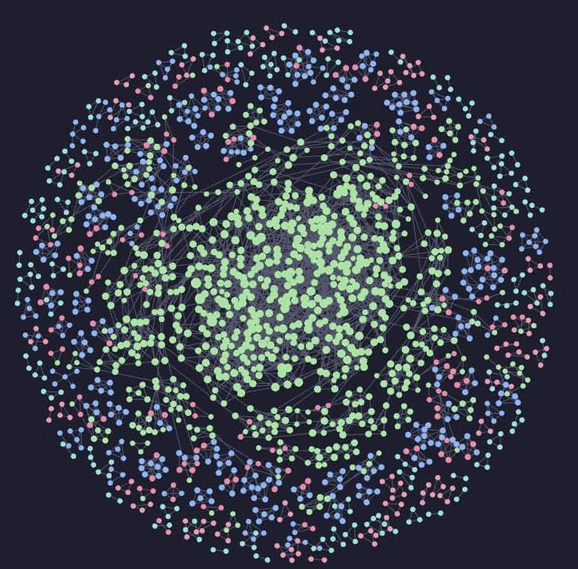
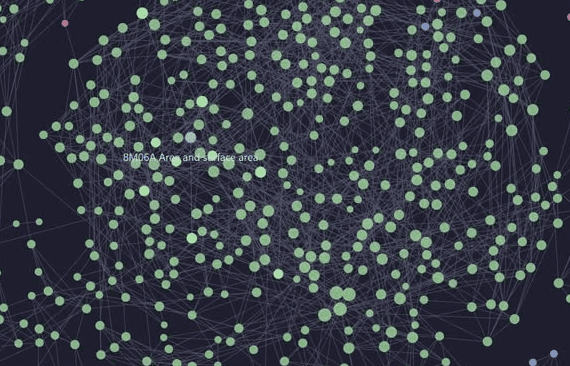
What this knowledge graph allows us to do is to examine and evaluate the coherence of our curriculum. To what degree are key understandings and skills built over time? Are there examples of key knowledge and skills that are missing, ill-fitting or under-represented? Is the development of these schema reflective of what the evidence base indicates about how these concepts are built over time? Are we aligned with the national and state curricula, while also offering an ambitious curriculum for our schools?
A coherent and knowledge-rich curriculum needs to be carefully created in order to strategically build subject knowledge and skill over time. The Ochre Education knowledge graph provides a system by which dependencies and relationships are visible both for curriculum creation and evaluation.
In our next blog, we will be discussing links in a knowledge graph, and how strength and directionality of links impact on curriculum design.